
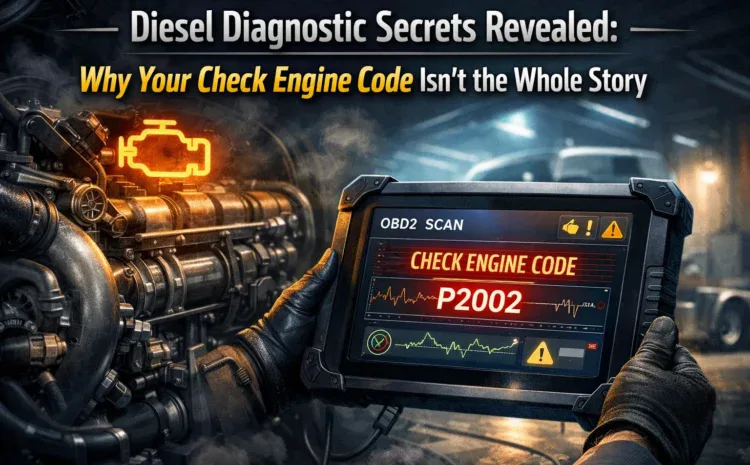
Diesel Diagnostic Secrets Revealed: Why Your Check Engine Code Isn’t the Whole Story
For any fleet owner or independent operator, that glowing amber light on the dashboard: the “Check Engine” light: is a universal symbol of frustration. It represents a potential interruption to your schedule, lost revenue, and an impending bill. In the high-stakes world of logistics and transportation, every hour your truck sits in a bay is an hour it isn’t generating income.
When that light flickers on, many drivers reach for a basic OBD-II scanner. They see a code, Google the definition, and assume they’ve found the problem. However, at Schimpfs Garage LLC, we’ve seen thousands of trucks come through our doors where a simple “parts-swapping” approach based on a generic code led to wasted money and unresolved issues.
The reality is that a diagnostic code is a starting point, not a final answer. Understanding the difference between a code and a true diagnosis is the secret to maintaining a profitable, reliable fleet.
The Myth of the “Magic” Code Reader
There is a common misconception that modern diesel engines are so advanced that they can tell you exactly what is wrong with them. While it’s true that Electronic Control Units (ECUs) monitor thousands of data points every second, they aren’t sentient. They don’t “see” a broken bolt or a clogged filter; they only see that a sensor’s reading has fallen outside of a pre-programmed range.
When you search for commercial truck repair near me, you need a partner that understands that a code is merely a symptom. For example, a code indicating “Low Boost Pressure” doesn’t necessarily mean your turbocharger is dead. It could be a cracked charge air cooler, a leaking hose, a faulty manifold absolute pressure (MAP) sensor, or even a restricted air filter.
If you simply replace the turbo based on the code, you might spend thousands of dollars only to have the light come back on ten miles down the road. This is why professional diesel engine repair requires more than just a scanner; it requires a deep understanding of how these complex systems interact.
Why Diesel Diagnostics are Uniquely Complex
Modern diesel engines are significantly more complex than their gasoline counterparts. To meet strict emissions standards and performance demands, today’s heavy-duty trucks rely on a fragile ecosystem of interconnected systems. When one component fails, it often triggers a “cascade failure” that affects multiple other systems.
1. Aftertreatment System Intricacies
The heavy-duty aftertreatment systems found on modern trucks are often the primary source of check engine lights. Systems like the Diesel Particulate Filter (DPF), Selective Catalytic Reduction (SCR), and Diesel Exhaust Fluid (DEF) injection are highly sensitive. A code for “Poor SCR Performance” might be caused by contaminated DEF, a crystallized injector, or an upstream engine issue that is causing excessive soot. Without advanced diagnostics, you’re just guessing.
2. High-Pressure Common Rail Fueling
Diesel fuel systems operate at incredibly high pressures: often exceeding 30,000 PSI. A minor deviation in fuel rail pressure can trigger a fault code. Is the pump failing? Is an injector leaking internally? Or is it a simple wiring harness issue? Finding the answer requires specialized electrical and battery diagnostics and mechanical flow testing.
3. Variable Geometry Turbochargers (VGT)
Many heavy-duty engines use VGTs to optimize power across the RPM range. These turbos have moving internal parts that can become stuck due to carbon buildup. A code for “VGT Actuator Position” might mean the actuator is bad, or it might mean the turbo’s internal vanes are seized. A basic reader won’t tell you the difference, but our team at Schimpfs Garage LLC can.
The Schimpfs Garage Approach: 60+ Years of Expertise
At Schimpfs Garage LLC, we don’t just read codes; we interpret data. With over 60 years of experience in the industry, we have seen the evolution of the diesel engine from mechanical simplicity to digital complexity. This historical perspective allows our technicians to combine “old school” mechanical intuition with “new school” digital precision.
Our diagnostic process involves several layers of verification to ensure we reach the root cause the first time:
- Advanced OEM-Level Scanning: We use the same high-level diagnostic software that manufacturers use. This allows us to see “freeze frame” data: exactly what the truck was doing (speed, temperature, load) the moment the code was triggered.
- Physical Inspection and Testing: We don’t trust the computer implicitly. If a code points to a cylinder misfire, we perform manual compression tests or use thermal imaging to verify injector performance.
- Smoke Testing and Pressure Testing: To find leaks in the intake or exhaust systems: common causes of performance codes: we use specialized equipment to pressurize systems and find the exact point of failure.
- Historical Data Analysis: Because we specialize in fleet services, we often know the common failure patterns for specific makes and models, allowing us to find “ghost” issues that others might miss.

The High Cost of Misdiagnosis
In the commercial world, a misdiagnosis is more than an annoyance; it’s an operational failure. If a truck is misdiagnosed, you suffer from:
- Direct Financial Loss: Paying for parts and labor that didn’t fix the problem.
- Extended Downtime: Every day the truck is in the shop is a day it isn’t earning.
- Secondary Damage: A faulty sensor left unaddressed can eventually lead to catastrophic engine failure or a melted DPF, turning a $300 repair into a $10,000 overhaul.
By choosing a reputable provider for engine and exhaust performance issues, you are investing in the long-term ROI of your equipment. Accurate diagnostics mean faster turnaround times and higher vehicle availability.
Preventative Maintenance: Your Best Defense
While diagnostics are essential when a light comes on, the most successful fleets use data to prevent the light from ever appearing. Regular general maintenance and inspections are the key to staying ahead of the curve.
During a routine service, our technicians can look at “pending” codes: faults that haven’t yet reached the threshold to trigger a dashboard light but indicate a developing problem. Catching a failing EGR valve during a scheduled oil change is significantly cheaper than dealing with a “derate” mode breakdown on the side of the highway.
If you do find yourself stranded, our mobile heavy-duty truck repair service brings our diagnostic expertise directly to you, minimizing the need for expensive tows and getting you back on your route as quickly as possible.

Trust the Experts for Your Diesel Diagnostic Needs
The modern diesel engine is a marvel of engineering, but its complexity requires a level of expertise that goes beyond what a basic auto shop or a handheld scanner can provide. Whether you are dealing with a recurring “Check Engine” light or looking to optimize your fleet’s performance, you need a partner who understands the “why” behind the code.
At Schimpfs Garage LLC, we pride ourselves on being that partner. We provide reliable, transparent, and highly technical diesel engine repair for American, European, and German commercial vehicles. We understand that your business relies on your trucks, and we treat every diagnostic challenge with the urgency and precision it deserves.
Don’t let a dashboard light dictate your schedule. Experience the peace of mind that comes with 60+ years of heavy-duty truck service expertise.
Ready to get to the bottom of your truck’s performance issues?
Contact us today to schedule a comprehensive diagnostic consultation or visit our Somerdale, NJ location to see why we are the region’s leader in commercial vehicle care. Let’s keep your fleet moving forward, efficiently and reliably.