7 Common Brake Issues That Put Your Truck Out of Service (And How to Avoid Them)
There is a specific kind of sinking feeling that hits your stomach when you see the flashing lights of a mobile inspection unit or pull into a weigh station during a CVSA Brake Safety Week. You know your truck is the lifeblood of your business, and every minute it spends sitting on the shoulder or in a secondary inspection bay is money bleeding out of your pocket.
At Schimpfs Garage LLC, we’ve seen it all. With over 60 years of combined experience, our team knows that a “simple” brake issue is rarely ever simple when it results in an Out-of-Service (OOS) order. The goal isn’t just to pass an inspection; it’s to ensure that when you’re hauling 80,000 pounds down a steep grade, your equipment responds exactly how it’s supposed to.
If you are looking for a reliable brake repair service to keep your fleet compliant, understanding what inspectors are looking for is the first step. Here are the seven most common brake issues that sideline trucks and, more importantly, how you can avoid them.
1. Brakes Out of Adjustment (The 20% Rule)
This is consistently the number one reason trucks are placed out of service. According to CVSA criteria, if 20% or more of the service brakes on a vehicle are defective or out of adjustment, the vehicle is grounded immediately. For a standard five-axle tractor-trailer, that means just two bad brakes can stop your entire operation.
Inspectors measure the pushrod stroke. If it exceeds the maximum allowable limit: even by a fraction of an inch: it counts as a violation. While most modern trucks use automatic slack adjusters, they aren’t “set it and forget it” components. They can fail, or the underlying hardware like S-cams and bushings can wear out, preventing the adjuster from doing its job.
How to avoid it: Don’t wait for an inspection to check your stroke. Regularly scheduled fleet services should include a manual measurement of the pushrod travel to ensure your automatic adjusters are actually working.
2. Audible and Visible Air Leaks
If an inspector can hear a hiss, you’re likely heading for a violation. Air leaks in chambers, lines, or valves are major red flags. A significant leak reduces the available pressure needed for emergency braking and can lead to a total loss of braking power if the compressor can’t keep up.
Common culprits include leaking glad-hand seals, cracked air hoses, or internal diaphragm failures in the brake chambers. These often start small and are easy to ignore in a noisy yard, but they become glaringly obvious during a quiet roadside inspection.
How to avoid it: During your pre-trip inspection, perform a proper air loss rate test. Shut off the engine, hold down the brake pedal, and listen. If you hear anything, it’s time to search for heavy duty truck repair near me before you hit the highway.
3. Worn or Contaminated Linings and Pads
Brake linings take a beating, especially in stop-and-go traffic or mountainous terrain. Inspectors check for thickness: typically looking for linings that are worn down to less than 1/4 inch at the steering axle or 1/8 inch for other axles.
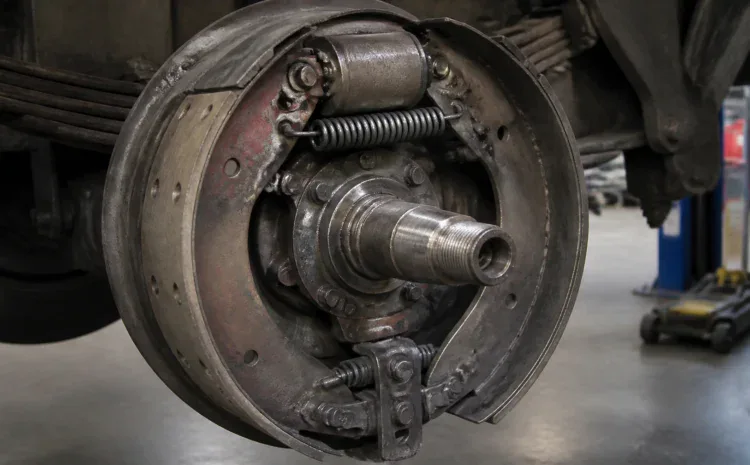
However, wear isn’t the only issue. Contamination from oil or grease is an automatic OOS defect. If a wheel seal fails and coats the brake shoes in lubricant, that brake is effectively useless. The friction needed to stop the drum simply isn’t there anymore.
How to avoid it: Look for “sweating” or dampness around the wheel ends during your walk-around. If you see grease on the inside of the tires or the brake backing plate, you need an immediate inspection of your wheel seals and linings.

4. Chafed and Damaged Air Hoses
Your air lines are the “veins” of your braking system. Because they are flexible and move with the suspension, they are prone to chafing against the frame or other components. If an inspector sees a hose that is worn through the outer reinforcement ply or one that is kinked and restricted, they will pull you off the road.
Bulges in the lines are even more dangerous, as they indicate an imminent blowout. Many drivers don’t realize that even a hose that isn’t leaking yet can be an OOS violation if the damage is deep enough.
How to avoid it: Use proper hangers and springs to keep lines away from moving parts. During your regular commercial truck repair near me visits, ask the mechanic to specifically check the routing of your air lines for any signs of friction.
5. Cracked or Broken Drums and Rotors
Brake drums handle incredible amounts of heat. Over time, this heat can cause “heat checking”: small hair-line cracks on the friction surface. While small cracks are often normal, any crack that opens up when the brakes are applied or a crack that extends through the entire thickness of the drum is a major safety hazard.
A cracked drum can literally fall apart under the pressure of an emergency stop, leading to a catastrophic wheel lock-up or loss of control.
How to avoid it: Avoid “riding” the brakes on long descents; use your engine brake instead. During tire changes or brake jobs, have the drums inspected for any structural cracks that go beyond surface-level heat checking.
6. Inoperative Steering Axle Brakes
The brakes on your steering axle are arguably the most critical for maintaining control of the vehicle. Any defect on a steering axle brake: whether it’s a mismatched chamber size, a disconnected linkage, or a completely inoperative brake: is an automatic out-of-service condition.
Inspectors pay extra attention to the front of the truck. If they find that one side is doing all the work while the other is unresponsive, you won’t be moving until it’s fixed. Mismatched slack adjuster lengths on the steering axle are another common “gotcha” that catches many fleet operators off guard.
How to avoid it: Ensure that components are always replaced in pairs across the axle. If you replace a chamber on the left, check the right. Consistency is key for steering stability and inspection compliance.
7. Faulty Low Air Warning Systems
Every truck is required to have a functional low air warning device (usually a light and a buzzer) that activates when pressure drops below 60 PSI. If your buzzer doesn’t sound or your light doesn’t kick on during the inspector’s test, your day is over.
This system is your last line of defense before the spring brakes automatically “pop” and bring you to a sudden, potentially dangerous halt in the middle of traffic. If you can’t trust your gauges and warnings, you shouldn’t be behind the wheel.
How to avoid it: This is the easiest test to perform yourself. Regularly drain your air tanks to check for moisture (which ruins valves) and trigger the low-air warning to ensure it’s still loud and clear.
Staying Road-Ready with Schimpfs Garage LLC
Keeping a heavy-duty truck or a full commercial fleet on the road requires more than just luck; it requires a proactive approach to maintenance. The cost of a roadside repair or a missed delivery due to an OOS order far outweighs the cost of a scheduled check-up.
At Schimpfs Garage LLC, we specialize in keeping you moving. Whether you need an in-shop brake repair service or you’re looking for heavy duty truck repair near me that can come to your location, we’ve got the tools and the experience to help. We even offer mobile alignments and repairs using advanced laser technology to ensure your truck is running as efficiently as possible.
Don’t wait for the DOT to find a problem for you. Let’s get your fleet inspected and serviced so you can drive with the confidence that comes from knowing your brakes are 100% compliant and, more importantly, 100% safe.
Give us a call or stop by the shop today to schedule your next brake inspection. We’re here to make sure you’re never left in the dark.